Rue de Douai
Maigret and the Dead GirlRue de Douai is the Paris location that connects a faded evening dress to the shop where Louise Laboine rented it, turning a garment’s label into a traceable address in Maigret’s investigation. The street is both a concrete point of inquiry and the setting for Louise’s precarious attempts to obtain suitable clothes without enough money to buy them.
Address and storefront
The dress bore a tab identifying “Mademoiselle Irene, 35b, Rue de Douai.” Maigret recognized the address as close to Place Vintimille, linking the garment recovered in the investigation to a specific part of Paris. The label’s practical information—shop name, number, and street—provides a lead where the dress itself might otherwise offer little explanation.
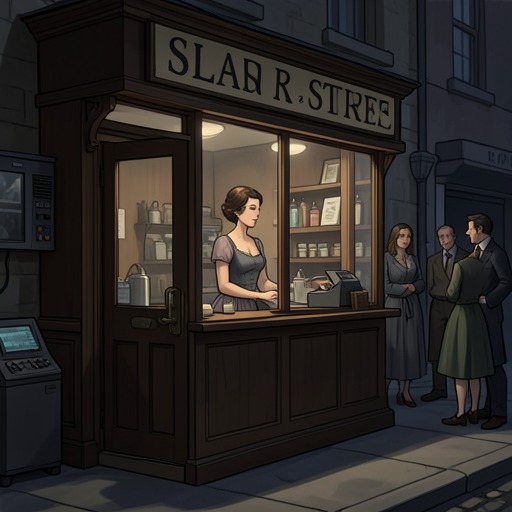
When Maigret and Lognon reached Rue de Douai, the street was deserted apart from a concierge standing in a doorway. At number 35b, they found a mauve-painted shopfront marked “Mademoiselle Irène,” with “Model Gowns” written below. Its dusty window displayed only two dresses, one white with spangles and one of black silk. The shop was closed when they arrived after half-past nine, although a light showed in the room behind it; Maigret knocked while carrying the brown-paper package from the Medico-Legal Institute.
Louise’s visits to the shop
Louise had first come to the shop soon after dinner, at about eight o’clock. She wanted an evening dress and admitted she could not afford to buy one; she asked whether the proprietor rented dresses. The garment later identified by its Rue de Douai label was the same dress she requested on her later visit.
Louise returned soon after nine on the evening before the investigation reached the shop. She asked whether the dress was still available and explained that this time she could not leave a deposit. In place of money, she offered the clothes she was wearing. The arrangement made the shop a temporary point of exchange: Louise left her own garments and changed into the evening dress there.
The rental did not supply everything she needed to leave suitably dressed. Louise also needed shoes and a coat, and the proprietor found her a velvet cloak cape that would do. The sequence makes the address relevant not merely as the place where the dress was acquired, but as the setting for Louise’s improvised effort to assemble an outfit despite her lack of cash.
The street as an investigative lead
The dress had been washed often, and when its hem was opened its color was visibly faded. Its condition marked it as a frequently used garment, while the tab preserved a precise commercial address. That small label directed Maigret from the evidence of the clothing to the shop, where the proprietor could describe Louise’s earlier rental and her return without a deposit.
Rue de Douai therefore enters the investigation through material particulars rather than through a dramatic public scene: a worn dress, a numbered address, a quiet street, and a shop whose lights remained on after its door had been locked. The contrast between the modest storefront and the importance of what its proprietor could establish gives the location its narrative function: it makes one of Louise’s otherwise obscure transactions legible.